Struggling to Access Dermatology Care for Vitiligo?

We are hearing from a growing number of people with vitiligo who are still being told that dermatology services “can’t help” or that there is “no effective treatment available”. For vitiligo patients, referrals are being declined at triage stage, or patients are being advised not to pursue a dermatology appointment at all.
This is deeply concerning, and if you have been affected by this then we may be able to help.
The treatment landscape for vitiligo has changed
Until recently, vitiligo was often treated very differently from other dermatological conditions. Many NHS dermatology departments historically did not routinely accept vitiligo referrals, largely because there was no licensed medicine specifically approved for its treatment. That position has now changed.
The NICE approval of ruxolitinib cream (Opzelura) for the treatment of non‑segmental vitiligo in people aged 12 and over is a significant moment. For the first time, there is a licensed, evidence‑based treatment option for vitiligo available within the NHS, alongside established second‑line options such as phototherapy.
This approval has the potential to transform vitiligo care, but only if people can actually access specialist assessment.

“There’s nothing we can do”
We fully recognise that NHS England is currently within a 90‑day implementation period, during which local services are working through pathways, funding arrangements and prescribing processes. So in reality some patients may be waiting until early June 2026 before they are able to receive a prescription. However, implementation periods are not a justification for refusing assessment altogether. At a minimum, people should now be able to:
- Be referred to dermatology
- Receive a specialist assessment
- Discuss diagnosis, disease extent and treatment options
- Be placed appropriately on waiting lists or pathways
We are still seeing patients being turned away at referral stage, sometimes using language that suggests vitiligo is untreatable, purely cosmetic, or outside the scope of NHS dermatology. This is outdated and, in some cases, incorrect.
Who the NICE approval applies to
To be clear, current approval applies to:
- People aged 12 and over
- With non‑segmental vitiligo
- Who have tried first‑line treatments without adequate response
- With particular relevance to facial involvement
We know this last point is causing confusion.
Facial vitiligo can sometimes be subtle or early, and may only be clearly identified using a Wood’s lamp, a tool generally available in dermatology clinics, not primary care. As a result, some people are being told their vitiligo is not “significant enough” to warrant referral, even though specialist assessment is precisely what is required to determine this.
We can help overturn dermatology referral refusals
With consent, we are sharing redacted correspondence that illustrates exactly what many patients are experiencing.
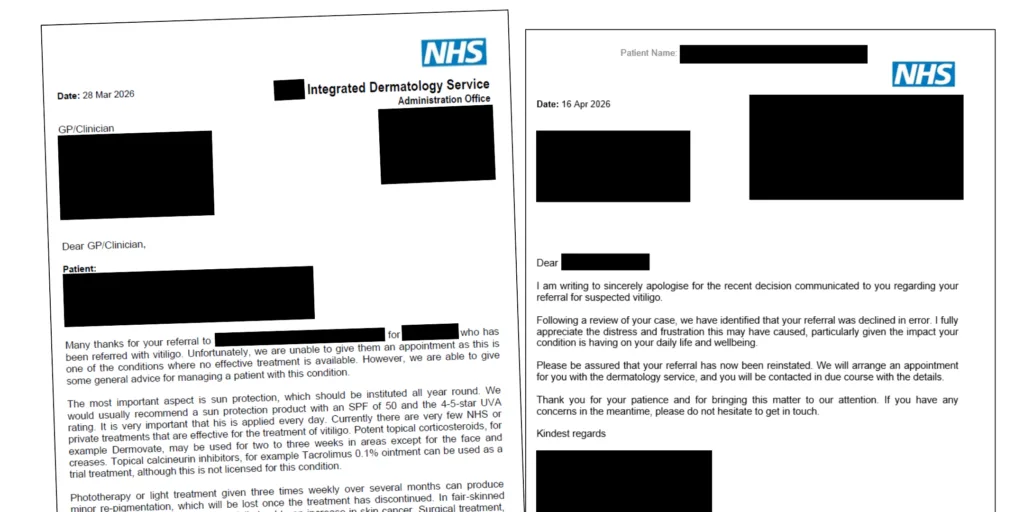
In one recent case, a patient with long‑standing non‑segmental vitiligo, including facial involvement confirmed under Wood’s lamp, had their dermatology referral declined on the grounds that “no effective treatment is available” (Redacted letter above). After we supported the patient to challenge this decision (referencing current guidance and emerging treatment options) the dermatology service reviewed the case, acknowledged that the referral had been declined in error, and reinstated the appointment.
A call‑out to our community
If you are based in the UK, and meet the above criteria for Ruxolitinib and are:
- Struggling to obtain a dermatology appointment for vitiligo
- Being told there is “nothing that can be done”
- Being turned away despite facial involvement or failure of first‑line treatments
- Receiving conflicting or confusing information about eligibility
We want to hear from you. Your experiences will help us:
- Identify systemic access issues
- Challenge outdated messaging
- Support individual cases where appropriate
- Advocate nationally for fair, consistent vitiligo care
We can help you challenge the decision and access the treatment and support you are entitled to. Contact our team today: hello@vitiligosociety.org

Please support our work! You've enjoyed 1 article this month and we hope you have found it useful. Our work is entirely funded by memberships and donations, so please consider joining our charity today and supporting our work.
Already a member? Log in