

Types of Vitiligo
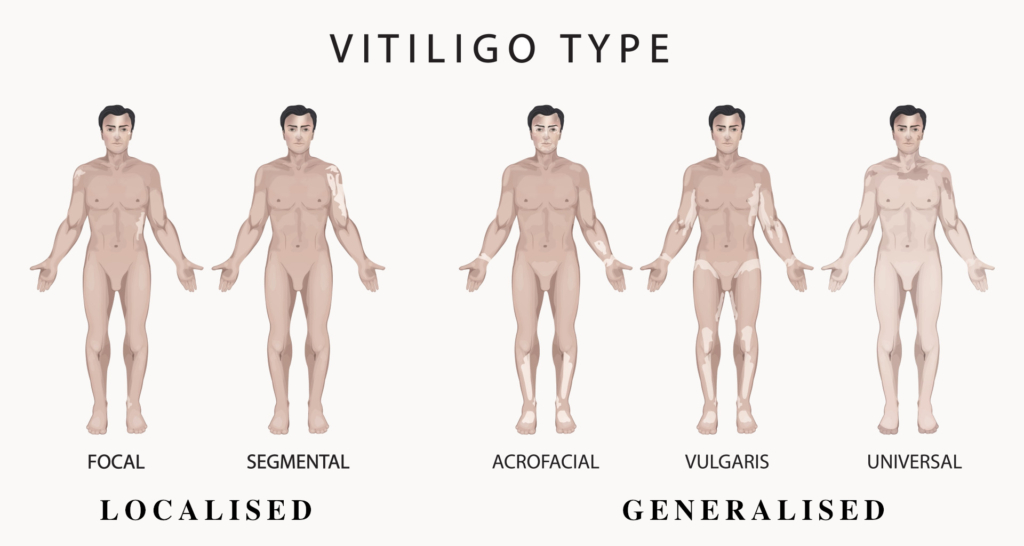
There are three main types of vitiligo. The type of vitiligo someone has is usually defined by how many patches are present, where they appear on the body, and how the condition behaves over time.
Focal vitiligo
Focal vitiligo refers to vitiligo that is limited to one or a small number of patches in a single area of the body. The patches do not follow a symmetrical pattern and may remain localised for long periods.
In some cases, focal vitiligo remains stable and does not spread further. In others, it may develop into a more widespread form over time. Because of this, focal vitiligo is sometimes considered an early or limited presentation rather than a distinct long‑term type.
Segmental vitiligo
Segmental vitiligo is a less common form of vitiligo. It typically affects one side of the body only and often follows a specific pattern or distribution. The patches usually appear within a defined area and do not cross the midline of the body.
Segmental vitiligo often develops earlier in life and tends to spread more quickly at first. However, once established, it is more likely to stabilise and less likely to continue spreading compared with non‑segmental forms.
Because of these characteristics, segmental vitiligo is considered distinct from other types and may be managed differently in clinical settings.

Generalised (non‑segmental) vitiligo
Generalised vitiligo, also known as non‑segmental vitiligo, is the most common form of the condition. It involves patches appearing on multiple areas of the body, often in a symmetrical pattern, meaning similar areas on both sides of the body are affected.
This type of vitiligo can progress gradually over time and may go through periods of stability and change. The extent and speed of progression vary greatly from person to person.
In some individuals, depigmentation becomes very extensive. In rare cases where most of the skin loses pigment, this may be described as extensive or near‑total vitiligo. The terms “universal” or “complete” vitiligo have historically been used, but are less commonly used in modern clinical guidance.
Why understanding the type matters
Identifying the type of vitiligo can help healthcare professionals:
- assess how the condition may behave over time
- discuss appropriate monitoring or treatment options
- set realistic expectations for management
It is important to note that vitiligo can behave differently in each individual, even within the same type. You may find additional, evidence‑based information about the types of vitiligo by visiting NHS overview of vitiligo page and the British Association of Dermatologists guidance on vitiligo.
Learn more about vitiligo
You may also find the following pages helpful:
Understanding Vitiligo: Learn more about causes, myths and who vitiligo affects
Diagnosis & Assessment: How vitiligo is diagnosed and assessed
Vitiligo Treatments: Information about treatment options and management