

Light Therapy For Vitiligo
Phototherapy for vitiligo involves controlled exposure to ultraviolet light, most commonly narrowband UVB or PUVA, usually delivered in a hospital setting. Phototherapy for vitiligo is typically delivered two or three times per week, depending on clinical advice. Some clinics may also offer home phototherapy as an option. Light therapy is also sometimes given with medication as well.
Light‑based treatment for vitiligo
Light treatment, which can include narrowband UVB and PUVA, is usually delivered in a hospital setting, where a person may need to attend two or three times per week. Some clinics may also offer home phototherapy as an option for suitable patients, following specialist assessment and training. Light therapy is sometimes given alongside medication, depending on individual circumstances.
Phototherapy for vitiligo typically requires multiple sessions over several weeks or months, and response tends to be gradual rather than immediate. Progress is monitored regularly, and treatment may be adjusted or stopped if there is no meaningful response after a defined period.

Factors to consider when deciding whether to have light treatment
Light treatments can be very effective, but people react differently to these treatments, as with the creams. To get light treatment, you will need to be referred by your doctor to a hospital dermatologist.
- It is most suitable for people who have large patches of vitiligo.
- Response to light treatment is variable. It is usually stopped after three months if there has been no improvement.
- If there is improvement, a course of treatment is likely to be long; often it can last for a year or more.
- It may be difficult to fit hospital visits in with your other commitments.
- Some people dislike the feeling of being shut in the light cubicle (although most get used to it).
- Treatments may bring about repigmentation, but this may not be permanent.
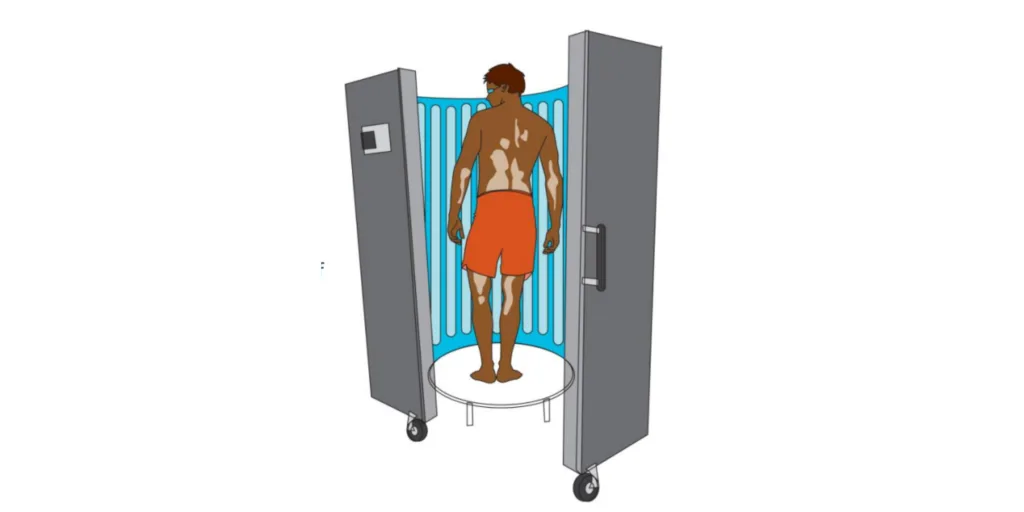
Light treatment is given by a machine which looks rather like a shower cubicle lined with fluorescent tubes. The amount of time you spend inside the cubicle is built up gradually in order to avoid burning. Treatment is usually given two or three times a week because it is not safe to give it more often. Any redness (burning) can take up to 24 hours to appear and needs to be protected from further exposure. During the treatment, you must wear wrap-around goggles to protect your eyes. You should also avoid looking directly at the rays of light. There are two


PUVA Light Vitiligo Treatment
Some hospitals offer PUVA treatment for vitiligo and involves taking medication as well as light treatment. The letters PUVA stand for Psoralen and UltraViolet light A.
Psoralens are chemicals found in plants, which make the skin more sensitive to light (either natural sunlight or UVA rays). Psoralen may be given as capsules to swallow, one or two hours before treatment. It may also be given as a lotion to paint on the white skin patches or to dissolve into bathwater (in which you have to soak for a short period before UVA treatment).
You should not take psoralens if you are pregnant. Since psoralen makes your eyes sensitive to sunlight, you need to wear dark glasses to protect your eyes for at least eight hours after taking the capsule. You also need to be careful that you are not taking or using other substances that are making your skin more sensitive to the UVA rays. These substances include some medicines, including complementary or herbal medicines. They also include coal tar or disinfectant soap and some deodorants, perfumes and aftershaves.
PUVA is used less frequently than in the past because of its side‑effect profile and longer‑term risks, and it is generally avoided in children.

Phototherapy for vitiligo: Narrowband UVB
Clinicians now use narrowband UVB as the most common form of phototherapy for vitiligo. It uses light of a specific UVB wavelength, which has proved to be more effective than using standard UVB.
There are a number of advantages over PUVA, narrowband UVB treatment:
- Narrowband UVB has several advantages over PUVA:
- It does not require additional medication, so no special precautions are needed before or after treatment
- Normal skin does not develop the deeper tan often seen with PUVA, reducing contrast between treated and unaffected skin
- Exposure times are shorter
- The light source reduces the potential long‑term risk of skin cancer compared with PUVA
- UVB treatment causes less skin damage
- It is considered a safer option for children
Treatment studies suggest that narrowband UVB is often more effective than PUVA, particularly for areas such as the face and trunk.
Combination treatments
In some cases, clinicians may recommend combining phototherapy with topical treatments, such as corticosteroid creams or tacrolimus. Using light‑based treatment alongside topical therapy can improve repigmentation outcomes for some people.
Combination treatment is carefully supervised by a healthcare professional to balance potential benefits with safety, particularly with long‑term use. Not everyone is suitable for combination therapy, and decisions are made based on disease activity, skin type and response to previous treatments.
Read more
Research & Treatment


Visit our Member Magazine
Thinking About Home Phototherapy for Vitiligo? Here’s What You Need to Know
Lifestyle

Visit our Member Magazine
Finding a Dermatologist to help treat vitiligo
Research & Treatment

Visit our Member Magazine
Everything you need to know about the use of phototherapy for treating vitiligo
Research & Treatment

Visit our Member Magazine
Results of the Hi-light Vitiligo Trial
What to expect from phototherapy
Phototherapy does not cure vitiligo, and results vary between individuals. Some people experience good repigmentation, while others see limited or no response. Even when treatment is effective, pigmentation may not be permanent.
Short‑term side effects can include:
- redness or mild sunburn‑like reactions
- dryness or itching
Because phototherapy involves repeated UV exposure, clinicians carefully monitor treatment duration and cumulative exposure. Treatment may be stopped if side effects occur, if there is no response after an agreed period, or if vitiligo stabilises.
Home Phototherapy
Home phototherapy usually involves uses smaller devices, which patients can use themselves at home. It’s the same type of light—but without the same level of monitoring and support unless part of a medical programme. The Vitiligo Clinical and Research Centre (Vitiligo CARE), based in the Midlands. They provide home handheld phototherapy as part of a monitored NHS service. Patients referred by their dermatologist are trained in how to use the device safely and are supported throughout the treatment course. Vitiligo CARE even accepts out-of-area NHS referrals, meaning you can access their help no matter where you live.
Hand-held devices are freely sold online on various websites and made by various manufacturers. All come with different instructions on how to use and how to treat your skin. However, phototherapy is a medical treatment and should be administered under the supervision of a doctor. Despite the convenience of treating your skin at home, there are real dangers when phototherapy is done without guidance from a healthcare professional.
Learn more about vitiligo treatment
You may also find these pages helpful:
Vitiligo Treatment Options: Overview of available treatments
Topical Vitiligo Treatments: Steroid creams and tacrolimus
How Vitiligo Is Diagnosed: Assessment and referral pathways
You may find additional evidence‑based information about phototherapy for vitiligo from the following organisations: NHS information on vitiligo treatment & British Association of Dermatologists guidance on phototherapy